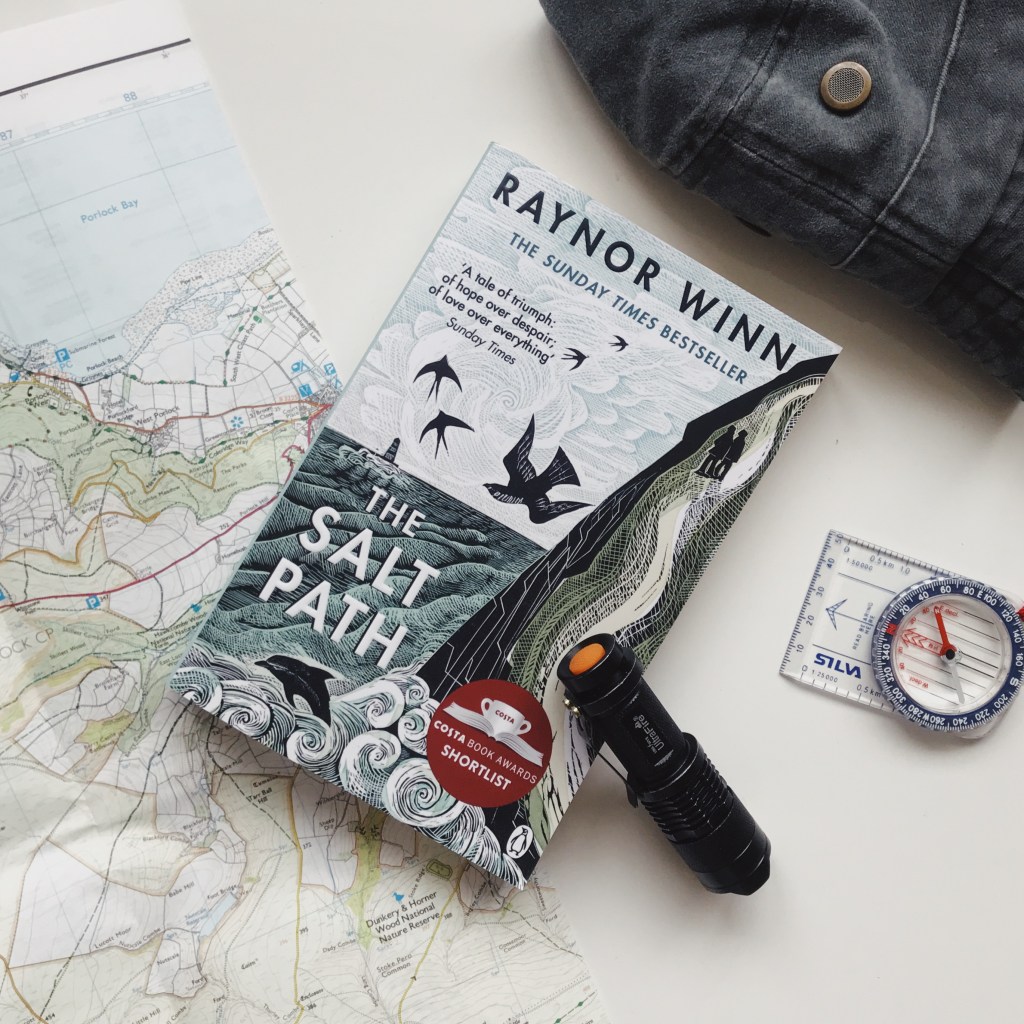
A couple in their fifties suddenly found they were without a home and without any income, and the husband facing terminal illness. So they decided to walk the 630 miles of the South West Coast Path, from Somerset to Dorset, via Devon and Cornwall. This book is a record and reflection of the journey.
It’s hard to review a memoir type non-fiction book. When I complain about a certain fantasy character or a fictional storyline, I’m only commenting on the work and the craftsmanship of a writer. To criticise a memoir is borderline criticising a real person’s life. But a memoir is still a book. It’s written down for anyone to read and as a reader, I’m entitled to voice my opinion. Although I will tread very very carefully.
So here we go.
Not sure what you think of long distance walking. Would you say it’s romantic? I certainly think it’s romantic … just not when I’m going uphill or downhill, and definitely not carrying a tent. We did it once, walked 18 miles in a day (my husband) carrying a tent. In the end, even going over a 200-metre hump ended up in whimperings and tears. There was nothing romantic about it.
Almost everybody the author, Ray, and her husband, Moth, met on the South West Coast Path expressed various amount of envy. “I wish I had the time to walk that far.” I’m not sure they all knew what they’re wishing for. It’s not fun to camp wild for weeks in British weather, with no proper food, no hot shower, no shelter in the rain and the wind.
I recently had a new level of understanding of just what the author and her husband did and a new level of admiration for their endurance. My husband and I had to sleep on a mountaintop for one night due to an Airbnb disaster, and that gave me a small glimpse of their state of homelessness and sleeping rough – anxiety, discomfort, sleepless night, cold weather, no way to wash, no access to a normal toilet, no hot water, no running water. That was just one night and we could afford to stay in a B&B the next day. But that was not an option for the author.
Then we had a couple of nights on a campsite and that gave me a small taste of minimum cooking and eating instant noodles day after day. With only a few notes in their pocket, Ray and Moth’s food options were limited to the cheapest things, which were usually noodles. They did all of the above, and more, for weeks and months.
Going on holiday is not fun when you don’t have a home to go back to. And they couldn’t pretend it was just a long holiday, because Moth was terminally ill.
The things the couple was going through were tremendous and their choiceless adventure was equally enormous. But halfway through the book I remember feeling the rest of the pages with a thumb and a finger thinking how much longer, I’m a bit bored. As they go through the motion of putting one foot in front of the other day after day, the text on the pages all blur into each other.
There were many distinct moments when they interacted with people along the way – and I loved those moments. But many human interactions were repetitive too: people commenting on their ‘old’ age, people admiring the length of their walk (which always ‘put a spring in their steps’), people avoiding them after hearing about their homelessness, people mistaking the husband for Simon Armitage, again and again.
The emotional undercurrent remained mostly the same. As I said, their grief was immense, and I don’t want to trivialise it. If I were the author, I would be just as angry and lost. But the book kept coming back to the grievance without developing it further. Or rather, it revealed everything in the beginning and emotionally had nowhere else to go. I was really glad to see her let go of the unchangeable and accept a new season at one point. But a bit later she was lamenting and furious once more.
But I guess the walk was when she went through her feelings little by little in circular ways. Thoughts and emotions are not linear. And the book recorded everything truthfully.
Raynor Winn’s second book is coming out very soon. I think I should read this again in ten years time and decide if I’ll read the second book. Life experience and wisdom show in writing. I believe it shows in reading too – and I am a reader too young for this book.
I sincerely hope Raynor will find her meaning and purpose, and as she wrote, that her life is not “bound to a patch of land”.




Leave a Reply