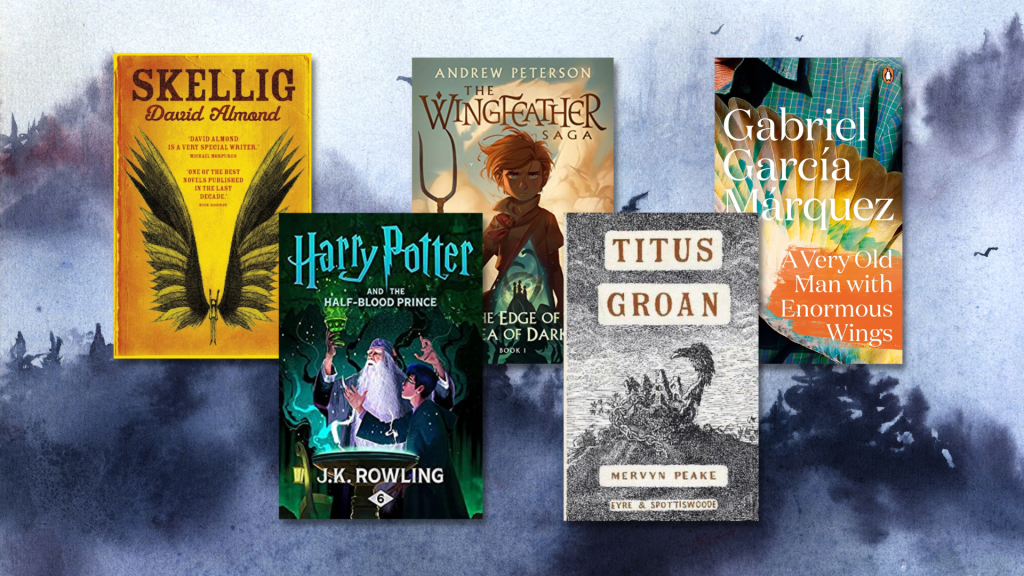
November was my fantasy reading month. I read two children’s books Skellig by David Almond and On the Edge of the Dark Sea of Darkness by Andrew Peterson, a short story A Very Old Man with Enormous Wings by Gabriel Garcia Marquez, Harry Potter and the Half-Blood Prince by J. K. Rowling, and Titus Groan by Mervyn Peake.
Skellig
The first book is Skellig by David Almond, an author from the North East of England where I live.
A boy called Michael and his family moved into their new home and his baby sister was born at the beginning of the story. But the new home was barely inhabitable, having been occupied by a lonely old man until he died without anyone noticing for days. There was a toilet in the corner of the dining room, there was a jungle in the back garden and there was a garage barely holding up. And his baby sister was born with a heart problem and kept going in and out of the hospital with their mum.
So even though Michael’s parents were alive and well and they lived together, they were both preoccupied, the mum with the baby, the dad with the house. I find it interesting that a lot of my favourite young protagonists don’t have parents or full access to their parents. Like in Harry Potter, A Little Princess, and Anne of Green Gables.
Anyway, while Michael was neglected, he discovered a half-dead man with wings called Skellig in their garage. This is what I find incredible, instead of telling his parents or calling the police, he hid the fact that Skellig was there and sneaked back to befriend him. Under the appearance of a homeless man or a highly unusual creature, Michael instinctively recognised something special about him. Instead of something to be alarmed at or to be got rid of, Michael reached out and cared for him.
Another major event was that Michael met a girl called Mina on his street. She was a bit too fierce for me. She seemed to be friendless although unlike Michael, she had a close relationship with her mum. Michael and Mina became friends and Michael shared the secret of Skellig with her.
I think the story is about friendship between children and how children see and understand those who are different from themselves. And that links to our second titles nicely. A Very Old Man with Enormous Wing, a short story by Gabrielle Garcia Marquez.
A Very Old Man with Enormous Wings
It was brought to my attention via a book with perfect timing, How to Read Literature Like a Professor by Thomas C Foster. He talks about it in a chapter on characters who have wings, who fly with or without wings, or who fall from the sky.
Foster says there are not many of them and this Very Old Man with Enormous Wings is one of the examples he gives. And I immediately thought I know another character who has wings aka Skellig and I was just about to start reading that story.
However, A Very Old Man with Enormous Wings makes a lot more sense than Skellig in terms of the message of the story. Partly because Prof. Foster gives an amazing interpretation of the amazing short story in the book. Partly because David Almond said he didn’t know where his story was going in an article on his website. If the author didn’t know where the story was going, could the story have a coherent message to it? I could be overthinking.
Back to A Very Old Man with Enormous Wings, the storyline has a lot in common with Skellig. A couple one day found A Very Old Man with Enormous Wings half dead in their backyard. They also had a sick baby. I’d believe it if this old man and Skellig are the same angel-bird-man creature. But how people responded to them was the very opposite. The rest of the story can be summarised as ‘Will you recognise an angel if the angel is entirely different to your expectation?’
On the Edge of the Dark Sea of Darkness
This was my third attempt reading On the Edge of the Dark Sea of Darkness. I finished it this time. I think it’s a trust issue. I didn’t trust the author Andrew Peterson as a writer, so I questioned the characters, the settings and the story. But many friends have said they enjoyed it and it was a lovely story, so I trusted the author and finished the story without much trouble.
It’s about the very ordinary Igiby children living with their mother and grandfather in an enemy-occupied country, how they got caught up in a series of unexpected events and ended up somewhere extraordinary that they wouldn’t have imagined possible at the beginning.
I loved the last few chapters best where things got a bit more exciting. On the Edge of the Dark Sea of Darkness is very much the beginning of their grand adventure and I guess in the following books, they will slowly become who they are supposed to be. I had the same feeling at the end of the Dune film – the first episode is just setting the scene and preparing us for the real adventure in the next episode, which is slightly unsatisfying.
Harry Potter and the Half-Blood Prince
I know this is a book post but the one thing that stood out to me from Harry Potter and the Half-Blood Prince was actually from the film adaptation. When Prof Slughorn told Harry about his mother’s gift – a lily petal turning into a wee fish, he said ‘it was beautiful magic, wondrous to behold’. I don’t think that line is in the original text and I don’t know which genius added it to the film. I love that line.
I love that magic is described as beautiful. When the struggle between the good and the evil is the main focus of the storyline, to be able to do powerful or clever magic seem to matter more most of the time. But in this instance, what Lily did was not useful or powerful, but beautiful. Somehow that stuck with me more than any other spells in the story.
Titus Groan
Titus Groan is the first book in the Gormenghast series by Mervyn Peake. We, as in, the world, only have three books in the series, Titus Groan, Gormenghast and Titus Alone. So it’s often called the Gormenghast trilogy. But at least two other books, Titus Awakes and Gormenghast Revisited, were planned but Peake died before he could write much more.
Titus Groan is the least active title character I had so far this year. It’s funny how the novel is called Titus Groan because he’s a newborn baby, he just get wrapped in cloth and carried around. So in that sense, the story is not about him. But in another sense, the story is ALL about him.
- First of all, the story kicks off because Titus was born.
Titus is the next Lord Groan, the 77th Earl of Gormenghast. The novel opens with the celebration of the newborn heir. It’s a natural cause for much joy and celebration, but the spectacles in the servants quarters are unnatural, out of proportion and sickening.
Out of the orgy and the endless maze of the gothic castle comes a young man called Steerpike. The actions of the novel are mostly about how Steerpike makes use of everyone ruthlessly to raise himself from nobody to praise and power.
Since the day Titus was born, everything happens for the worse because of Steerpike. There’s plotting, deceit, manipulation, murder, mysterious disappearance and death. That keyword summary makes it sounds like any generic historical drama that involves a throne and a succession situation. The novel is certainly NOT a generic historical drama.
The writing style makes it impossible to think of it that way. But even if we just stick to the storyline, I think the plotting and murder are on the surface level, there might be more to it than meets the eye. And I don’t mean there are bigger and more evil plots hidden behind. Quite the opposite.
- And that’s the second reason I think the story is all about the baby Titus.
Through him, I feel like good is going to come out of all the disasters in following books. In that respect, Titus Groan is like On the Edge of the Dark Sea of Darkness, the author clearly has multiple books in mind and each book is not quite a standalone story – there is definitely a climax at the end of Titus Groan, but there isn’t a conclusion. It mostly introduces the characters and sets the scene.
We can’t quite tell yet, how Titus is going to make the difference or where the story is going. If we can’t, why do I think good might come out of evil? It’s in the climax and how the author uses weather and imagery from biblical stories to construct that sense of hope. I’ll talk about that amazing climax in a separate post because I have so much to say!
- The last reason I believe the novel is about the baby is that, after all, the author named the novel after him!
It’s quite unusual for the title character to be newborn at the beginning of the novel and age one by the end. I had to trust the author that ultimately, the story is about him, even when I can’t see the connection.
One interesting feature of the novel is its collection of unconventional characters. Their faces and figures are ugly and caricature-like, I’ve never read a book with so many odd-looking and odd-behaving people in it. The author seems to emphasise one or two aspects of their personality so their behaviours are extremely consistent and predictable to the extent of absurdity. Reading the story sometimes feels like walking in a Victorian madhouse.
Another feature of the story is the role that nature plays. There’s a lot of description of the natural environment of the castle, of the weather, how the sun rises and sets when a person roams the wilderness alone, how the air and the night sky change when a young man tries to keep warm outdoors, how it rains and thunders on a night of murder. It’s very much in the tradition of Thomas Hardy, if he knew, I think the old master would have been very proud of Mervyn Peake.