In his book The Genius of Shakespeare, Jonathan Bate quotes Majorie Garber:
Imagine for a moment a scene set in Arthur’s bosom… seated at a table… are Shakespeare and Marlowe, busy playing what looks at first to be a game of cards. But when we get a little closer, we can see that instead of cards, they’re using plays – each has a handful of quartos, octavos, and, on Shakespeare’s part, some sheets of folio. Marlowe plays first, and he puts down The Jew of Malta. ‘The Merchant of Venice,’ Shakespeare replies, laying down a quarto from his own hand. ‘Dido Queen of Carthage,’ says Marlowe. ‘Antony and Cleopatra,’ Shakespeare answers. Now Marlowe, considering, puts down Edward II, and Shakespeare counters immediately with Richard II. ‘Dr Faustus,’ offers Marlowe, in some desperation, but with a half-smile of triumph. A pause – and then Shakespeare says softly, ‘Macbeth.’ Marlowe takes a deep breath, and looks through his depleted hand. Finally he speaks. ‘Tamburlaine the Great Parts One and Two.’ And Shakespeare, with an apologetic smile, lays down his cards. ‘Henry IV Part One,’ he says deliberately, ‘Henry IV Part Two, and Henry V!’
Today we will be talking about Shakespeare, we’ll be talking about Richard II, we’re also going to talk about Edward II and its author, Shakespeare’s contemporary Christopher Marlowe. As we just heard in this fictional scene sketched out by Majorie Garber, Shakespeare and Marlowe had an intriguing relationship in their theatre career. The real matter is far more complicated than this story, but the sense of rivalry is the key. Quoting one of my favourite authors and Shakespeare scholars Jonathan Bate, “Shakespeare, I suggest, only became Shakespeare because of the death of Marlowe.”
I always knew Shakespeare is a genius. However, It took me a while to put the puzzle pieces together and realise that Shakespeare is not a genius out of a vacuum. The story matter and the characters in his plays are often reworkings of older stories or historical figures. His ability to create memorable heroes and villains, enduring comedies and tragedies, and those fabulous soliloquies, grows partly from his grammar school education and partly from his responses to the dramatists of his age. And among all contemporary colleagues and competitors, quoting Jonathan Bate again, “alive or dead, he had no rival but Marlowe.”
I’m going to look at the two plays and the two authors together in one long 2-part discussion. In this part-1 post, we’ll look at the two playwrights, then a little bit about the two kings in the titles in English history, before I give you a few production recommendations and a summary of the plays. In part-2 we’ll dive deeper into the themes and characters of both plays.
Two playwrights
First of all, our playwrights. Biographers keep saying we know very little about Shakespeare, but the actual biographies are mostly still pretty chunky. We also know precious little about Christopher Marlowe.
Marlowe was born and baptised in 1564 in Canterbury in the South East of England, two months before Shakespeare was born in Stratford upon Avon. Both came from humble family backgrounds: Shakespeare’s father was a glover, Marlowe’s father was a shoemaker. Both survived the plagues, both the eldest of their surviving siblings. Both went to grammar school as boys, Marlowe in The King’s School in Canterbury, Shakespeare in The King’s School in Stratford, and received almost identical education in Latin and classical texts. Both sat under the same teachings of the Church of England. Marlowe went on to Cambridge University and graduated with a bachelor’s and a master’s degree, while Shakespeare disappeared from records for a few years until he emerged in London’s theatre world.
We have little to go on about both men. But there are written historical records that survive to this day. Those scraps of paper give us an interesting sketch of each person, and putting them side by side, despite their parallel early life and their careers as dramatists, they start to look like very different men.
For Shakespeare, apart from his baptism, marriage, his will and his death, we have historical documents related to his career: the theatre companies that he was part of, payments for performances, a legal dispute over the lease of a theatre site, and of course, the First Folio. There is evidence of him getting rich, but it’s not always associated with a positive image:
- Him buying properties, one in Stratford, one in London.
- His name appearing in tax records which indicate his locations of residence in various parts of London.
- Him hoarding grain in Stratford during a time of food shortage.
There is the unique Mountjoy Case where Shakespeare was one of the witnesses in a lawsuit between his former landlord, Christopher Mountjoy, and Mountjoy’s son-in-law.
Overall, Shakespeare was moving deftly in various circles in London and rising steadily above his neighbours at home in terms of finance and class. Dry historical records give fascinating insight into one’s personality. The picture is very different when you turn to Marlowe: Life is full of drama and flare.
There’s a meeting minute from the court about his long absence from uni which nearly cost him his degree, but instead of regular student skiving, Marlowe seemed to have “had done her Majesty good service” during these mysterious absence. Many interpret this as a hint of Marlowe’s intelligence service spying on the Roman Catholics in Europe which was one of Elizabeth’s major headaches at the time.
There are also records of him getting into money trouble, imprisonment for stabbing a man to death, being arrested for counterfeiting coins abroad, and arrested again for fighting with weapons. If Marlowe was a spy of Elizabeth’s, he was not very good at staying under the radar. I can imagine William Cecil, the Queen’s chief counsellor, holding his exasperated forehead.
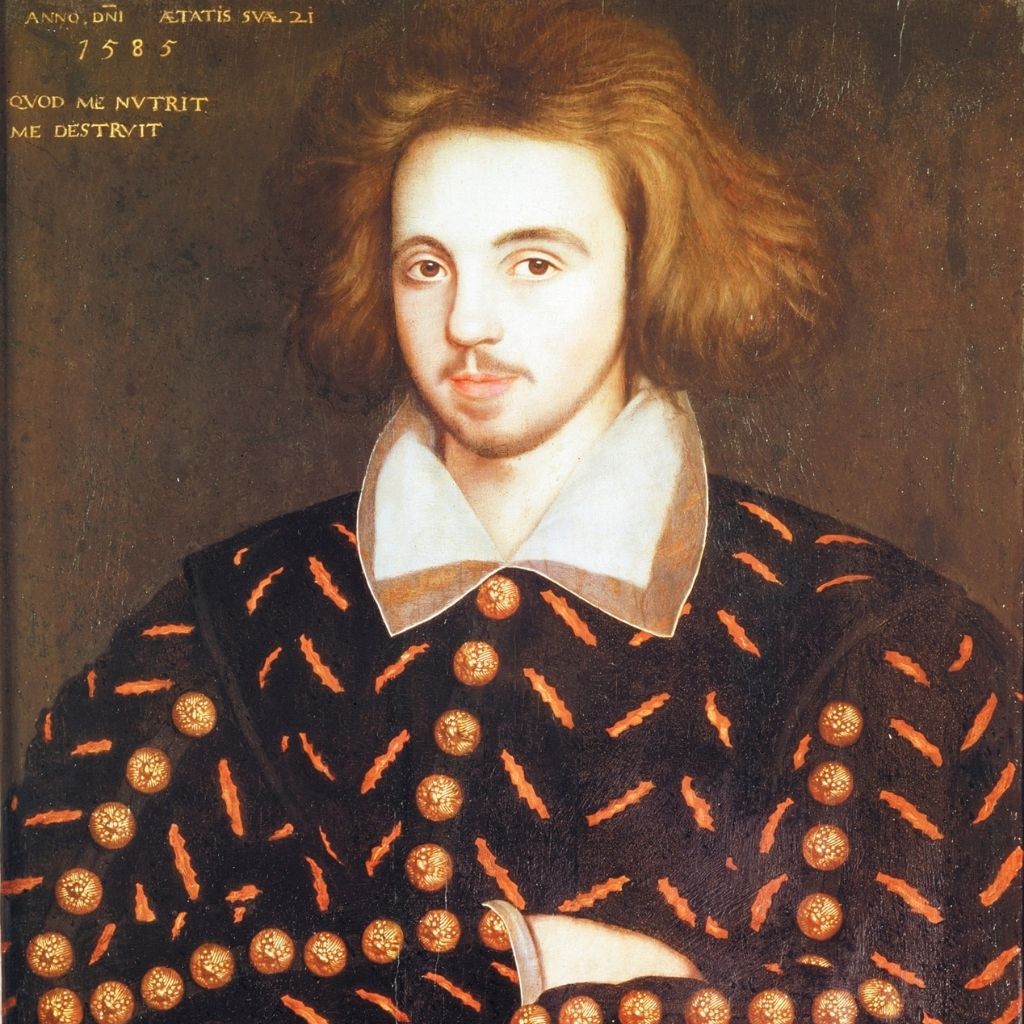
Marlowe famously died in a tavern brawl which might have been an assassination related to his espionage, or his overt blasphemy and atheism or something else. Four people walked into a room, Marlowe came out horizontal, and dead. Remember the portrait of Marlowe? He looked so young because he died so young. He was the boy genius even more so than Shakespeare. Kit Marlowe was a box office superstar with his six plays on the London stage in 1593 when he was 29, the year he died, by which, Shakespeare had barely started his career.
Marlowe’s works and influence on Shakespeare
Six plays are attributed to Christopher Marlowe. In no particular order, because we don’t know when they were written:
- Tamburlaine the Great Parts 1 & 2 (published 1590)
- Doctor Faustus (published 1604)
- The Jew of Malta (published 1633)
- The Massacre at Paris (published 1593)
- Edward II (published 1594)
- Dido, Queen of Carthage – written with Thomas Nashe (published 1594)
Jonathan Bate suggests that it took Shakespeare his whole career to learn, compete and overcome Marlowe’s genius, the one-sided rivalry lasted long after Marlowe’s death. We don’t have time, nor am I qualified to talk about how each of Marlowe’s plays influenced Shakespeare. If you are interested, please read the chapter called Marlowe’s Ghost in The Genius of Shakespeare by Jonathan Bate. This is how I was first introduced to this subject and I don’t wish it to have been brought to my attention by any other way. It was such a pleasure to read this book and to follow the author’s mind, the wonderful imagination combined with seamless argument in his beautiful writing. Jonathan Bate is poet and scholar rolled into one.
History of Kings: who’s who
That’s enough about the playwrights for now. Let’s move on to English history, just very briefly, especially the family tree between Edward II and Richard II.
Edward II is the son of Edward I, who is mentioned briefly in the play. Our Edward started his reign in 1307. So for an Elizabethan audience, this is historical drama of their own nation from about 300 years ago. The distance is like that between us and Alexander Pope, Daniel Defoe and Jonathan Swift.
Edward II lasts for about 20 years on the throne and is succeeded by his son Edward III who rules England successfully for the next 50 years.
Edward III’s eldest son is the Black Prince, another Edward, who died before Edward III. The Black Prince has several children and step children, the surviving legitimate heir is Richard II. Because his father the Black Prince died before his grandfather Edward III, Richard II becomes the king of England after his grandfather, in 1377. So in short, Edward II of Marlowe is the great grandfather of Richard II of Shakespeare.
Richard reigns from age 10 for 22 years and is deposed and succeeded by Henry Bolingbroke, Henry IV. Richard died in Pomfret Castle, the ruin of which you can still see in Pontefract in West Yorkshire.
Now we leave history and move on to our plays. Just to state the obvious, the plays are fictional and dramatised. They are not historical documentary. The characters and story lines are not always true to the historical figures and details. Our interests are in what happens in Marlowe and Shakespeare’s versions of history and how they portray the characters, in the plays.
The shows
I’m going to recommend a few productions for you to listen to or watch.
Edward II is not performed very often. I was fortunate to watch the recent RSC production in Swan Theatre in Spring 2025 but I don’t know if it’s available on online streaming platforms yet. There are plenty trailers on YouTube for you to get a feel of it. There is a 1991 film directed by Derek Jarman which I haven’t watched so can’t comment. There is a BBC Radio drama that I can definitely recommend, featuring Toby Jones playing the title role.
There are a lot more choices for Richard II. There is the BBC Radio drama. This is the series I default to when I get to any Shakespeare’s plays.
On screen, my favourite remains Ben Whishaw in BBC The Hollow Crown series. A very young Ian McKellen version is available on Shakespeare Network on YouTube for free.
There’s the 2013 David Tenant one by RSC and 2015 Charles Edwards one by Shakespeare’s Globe. Both you can find on streaming platforms for a fee. There’s a recent one by Jonathan Bailey by Bridge Theatre in London. I hope it will become available online at some point too.
Plot Summaries
We’ll focus on Gaveston and Edward’s relationship in the part-2 post as well as compare and contrast one of the equivalent scenes in both plays. I think it’ll be useful to do a summary of both stories before we get into the details.
So here’s Edward II by Christopher Marlowe. King Edward II ascends the throne of England and immediately recalls his exiled favourite, Piers Gaveston, whose close and possibly romantic relationship with the king causes outrage among the nobles and, for Queen Isabella, heartbreak. Gaveston’s influence over Edward leads to political instability and resentment, especially from the powerful baron Mortimer. The nobles eventually capture and execute Gaveston, but Edward refuses to reconcile with them and instead elevates new favorites, the Spencers, further deepening the divide. Isabella, feeling betrayed and politically marginalized, allies with Mortimer and launches an invasion from France. They capture Edward and force him to abdicate in favor of his young son, Edward III. Edward II is imprisoned and ultimately murdered in a brutal and symbolic way. In the final act, young Edward III takes revenge by executing Mortimer and asserting his authority. The double tragedy is brought to a close. History carries on.
Richard II by Shakespeare begins with a dispute between two nobles, Bolingbroke and Thomas Mowbray, which Richard resolves by banishing both men—Bolingbroke for ten years (later reduced to six) and Mowbray for life. Shortly after, Bolingbroke’s father, John of Gaunt, dies, and Richard seizes his estates to fund a war in Ireland, an act that alienates and angers many nobles. Bolingbroke returns from exile while Richard is in Ireland, gathering support to reclaim his inheritance. As Richard loses allies and political control, Bolingbroke gains momentum. Eventually, Richard is captured and brought back to London, where he is forced to abdicate. Bolingbroke is crowned King Henry IV. In the final act, Richard is imprisoned and murdered, likely under ambiguous orders from the new king. The tragedy of Richard ends. Again, history carries on.
See you in Edward II and Richard II part-2.


Leave a comment